Plant a tree that shades your house in summer, not in winter
Sun on the walls decides whether a house overheats in summer and how much free warmth it gets in winter. A well-placed deciduous tree can help with both; a badly placed one takes the winter sun and leaves the hot walls exposed.
Open the summer sun map →Free, in your browser. Needs a device with WebGL.
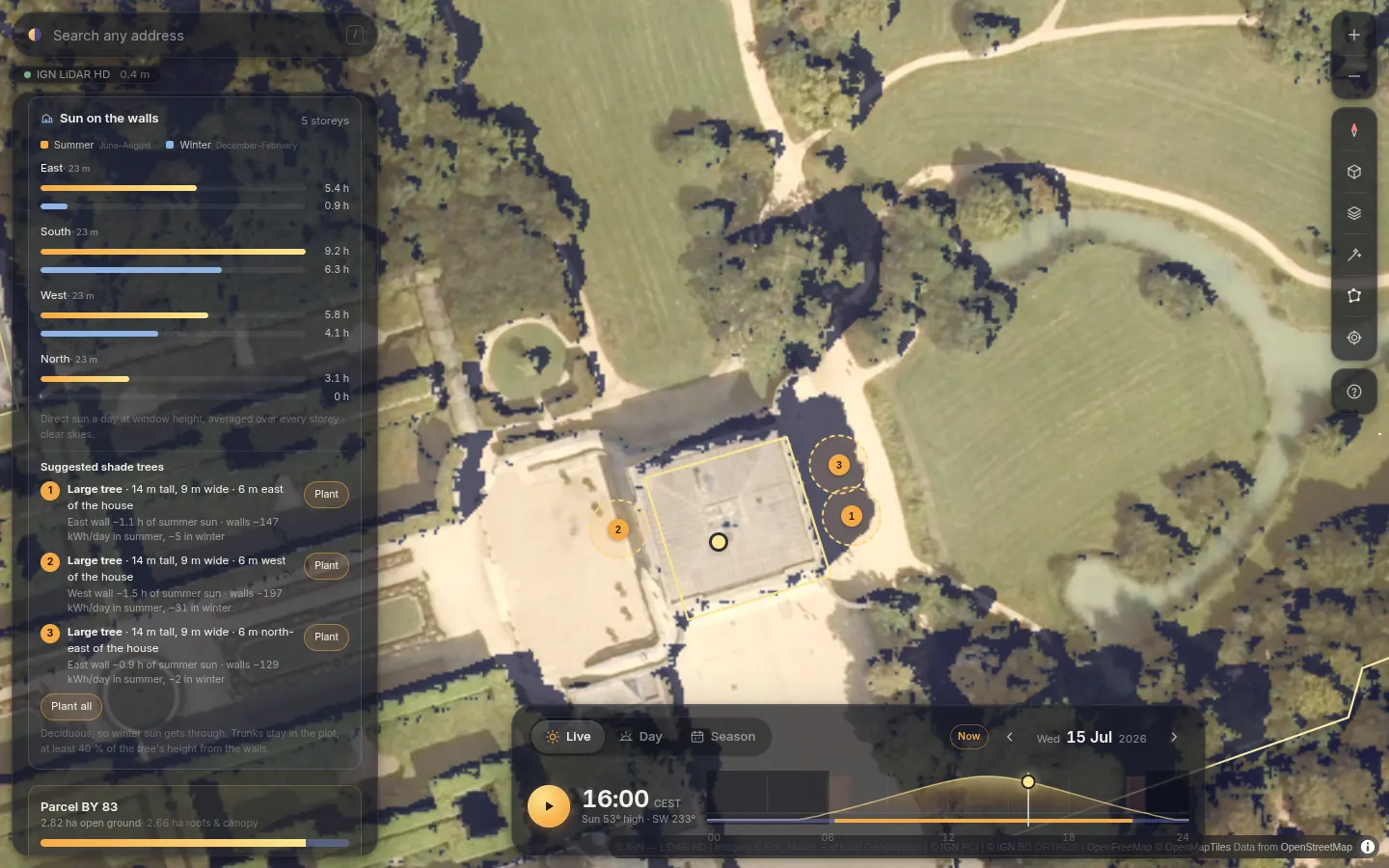
Sun on the walls
Pin a building and Sunshade shows how much direct sun each façade gets per day in summer (June to August) and winter (December to February), at window height on every storey. Add imaginary trees and each figure shows what they take away, so you can see whether a tree shades the house in summer without stealing its winter sun.
Suggest shade trees
Suggest shade trees does the search for you. It tries around a thousand deciduous trees, small, medium and large, on open ground around the house inside the plot, and proposes up to three that keep the most summer sun off the walls while costing little winter sun. Winter sun counts double, each tree must keep at least three times more sun off in summer than it costs in winter, and trunks stay at least 40 % of their height away from the walls.
One click plants the suggestions as what-if trees. Drag and resize them, and use Show what changes on the Day or Season map to see the sun they take away (in indigo) or add. What-if changes travel in the share link, so you can send the plan to someone else.
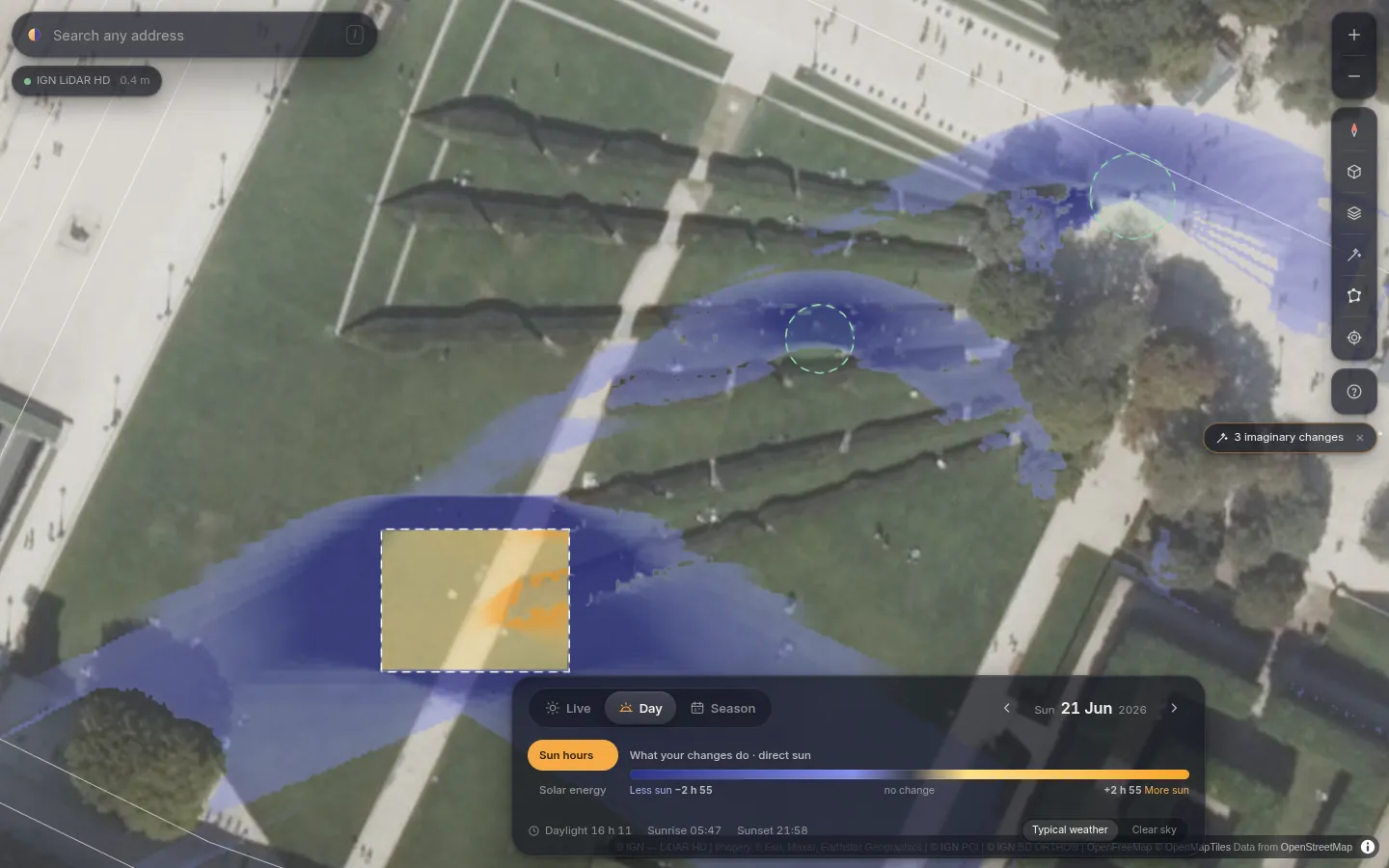
What the model assumes
Imaginary trees are real shapes: a trunk and a crown that low sun can pass under. A deciduous crown stops 85 % of direct sun in leaf and 35 % when bare, and is in leaf from about 20 April to 31 October (mirrored south of the equator). Wall sun is direct sun under clear skies, averaged over storeys at 1.5 m above each floor. Real trees from the survey stay solid and in full leaf all year.
Where the data comes from
Where countries publish national LiDAR surveys, Sunshade uses them directly: France (IGN LiDAR HD, with photogrammetric surfaces where LiDAR isn't available yet), the Netherlands, Flanders, Switzerland, England, surveyed parts of Scotland and Canada, Norway, New Zealand, North Rhine-Westphalia and Mecklenburg-Vorpommern. Everywhere else it builds an estimate from OpenStreetMap buildings, a global tree canopy-height map and terrain. The estimate shows big shadows (towers, streets, hills) well and small ones (a hedge, a shed) poorly; the status pill in the app always says which source you're looking at. All of it is open data, fetched live by your browser, and the shadows are computed on your own graphics card.
Open the summer sun map →